We are super excited at the Koffler this week – we’ve officially announced & launched our new season!
Our 2011-12 Program + Classes Guide is hot off the presses…. swing by and pick up a copy, or keep your eyes on your mailbox. You can also download a digital version on our website here. This is the guide to keep and refer to all year long – it comprises the full range of our off-site exhibitions, literary, music, dance and visual arts programs and classes. As always, full details on all of our classes and programs are on our website at www.kofflerarts.org.
The 2011-12 Fall/Winter Spring season is packed full of exciting programs, events and classes all over the city and at our home base on the Sherman Campus. A big change this new season is that the Toronto Jewish Book Fair – which is entering its 36th year – has been moved from its usual October time slot to June 2012 and has been renamed the 1st Annual Toronto Jewish Book Festival. The Festival, from June 4 to June 7, 2012, will now be downtown at the Bram and Bluma Appel Salon (Toronto Reference Library) and will include the same great author talks and programs and hundreds of books for sale as other years. The Festival will culminate in the Helen and Stan Vine Canadian Jewish Book Awards on June 7, 2012.
Other highlights this season:
Spin Off: Contemporary Art Circling the Mandala, September 22 to December 4, 2010 – A multimedia exhibition featuring six artists that meld mysticism and popular culture, offering alternative portals to escape the world of the everyday. With Aya Ben Ron (Israel), Mircea Cantor (France/Romania), Vandana Jain (USA), Gary James Joynes/Clinker (Canada), Melissa Shiff (Canada), Jennifer Zackin (USA). Koffler Gallery Off-Site at 80 Spadina Ave., Suite 501.
The Koffler @ IFOA, October 23, 2011 – one full day of author talks focused on Russian-Jewish stories presented by the Koffler at the International Festival of Authors at Harbourfront Centre. Authors include Gary Shteyngart, David Bezmozgis, Irwin Cotler, Gal Beckerman and Michal Govrin.
Yair Dalal and Frank London, March 28, 2012 – the world premiere of international music greats Yair Dalal and Frank London together, playing a one night concert featuring Middle Eastern/Eastern European music with guest musicians at the St. Lawrence Centre for the Performing Arts.
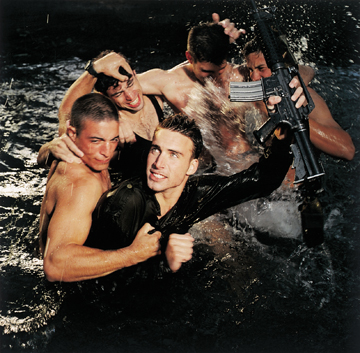
Adi Nes, April 26 to June 2, 2012 – the first major Canadian survey of Adi Nes, the acclaimed (and often controversial) Israeli photographer who interprets Biblical, mythological and literary subjects while exploring notions of masculinity, sexual and cultural identity.
Plus, we’ve partnered with the Art Gallery of Ontario for their major fall exhibition on Chagall and the Russian avant-garde. Past Present, on December 14, is an evening of music, dance, performance, spoken word and more with Toronto’s brightest avant-garde artists; and the Koffler Chamber Orchestra opens its season on November 20 with Chagall’s Musical World in Walker Court at the AGO.
Hope to see you out at Koffler events this new season!
[Images from top: Gary James Joynes/Clinker, Ouroboros 4.06 kHz, 2011; Gary Shteyngart; Yair Dalal and Frank London; Adi Nes, Untitled (soldiers in water), 1999. Courtesy of Jack Shainman Gallery; Adi Nes, The Last Supper.]
Showing posts with label Koffler. Show all posts
Wednesday, August 24, 2011
Tuesday, June 7, 2011
Canadian Jewish Book Awards 2011
The 2011 Helen and Stan Vine Canadian Jewish Book Awards ceremony took place last Monday at the Toronto Reference Library. It was an inspiring evening that took place in a great venue. All of the award winners were present to receive their awards and speak a few words, and the evening was hosted by the New York Times bestselling author, Michael Wex.
My problem is that after hearing about all the books, I want to read them. I already had a never ending list of books to read and, inevitably, the list has grown to never ending + 6. Whether you'll travelling, spending time on the beach, or just relaxing on the patio this summer, Far to Go, The Jew Is Not My Enemy, An Italian Renaissance: Choosing Life in Canada, Mordecai: The Life and Times, The Defining Decade: Identity, Politics, and the Canadian Jewish Community in the 1960s, and The Cry of the Giraffe are all highly recommended for summer reading.
Michael Wex - emcee for the evening.
Tarek Fatah receives his award for The Jew is Not My Enemy.
Dorothy Shoichet presents the award to Charles Foran for Mordecai: The Life and Times.
Alison Pick and Harold Troper sign copies of their books Far to Go and The Defining Decade.
For more photos of the event, check out our flickr photostream.
Casandra Campbell
Photos by Nick Kozak
Monday, November 22, 2010
Music That Survived
On November 7, in conjunction with Holocaust Education Week, the Koffler Chamber Orchestra performed a concert featuring music that survived persecution during World War II. It was a wonderful opportunity to hear music from composers whose careers were interrupted or cut short as a result of the Holocaust. Some of the composers are well known and their music is often performed while others have never really come to be celebrated. All of them have fascinating stories. Below is a brief bio on each of the composers featured in the concert that explains how the Holocaust affected their career.
Paul Hindemith
Paul Hindemith (1895-1963), a prominent German composer, was a reputable musician well before the 1933 election that brought the Nazi Party to power, and had already composed Five Pieces for String Orchestra. Hindemith was viewed as a talented composer and performer—having played both the vioin and viola—and was widely respected within the German music community. Although Hindemith was not Jewish himself, many of his close colleagues were (including his father-in-law Franz Schreker), and his music was not left untouched by the Nazi Party. His opera Mathis de Maler whose central character is an artist living in a repressive society, mirrored Hindemith’s own experience under the Nazi Party and led them to attack him in the press. As opportunities for Hindemith in Germany began to dwindle, he started finding more and more work outside of Germany , mainly in Turkey and Switzerland . Eventually a ban was placed on any performances of his works, and fearing a threat to his and his Jewish wife’s lives, they fled Germany and eventually settled in the United States. There, Hindemith obtained employment at Yale University where he continued to compose.
Pavel Haas
Pavel Haas (1899-1944), a Jewish Czech composer, likely never reached the height of his potential as a musician. During the German occupation, like many Jewish composers, performances of his works were banned. Haas was imprisoned in Terezín and later died in Auschwitz. However, while in Terezín, Haas composed some of his best-known works, including the Study for String Orchestra, which was featured in a Nazi propaganda movie intended to demonstrate the purported good living conditions for Jews in Terezín. After being shown conducting in the film, Haas was sent to Auschwitz only days later. Study for String Orchestra, remains one of his most performed pieces to date.
Mark Kopytman
Mark Kopytman (1929-), whose Kaddish for Cello and String Orchestra was only composed in 1992, is a living example of “We Who Survived.” Born in 1929, in the former Soviet Union , Kopytman was only ten years old when World War II broke out. Kopytman received training in piano and music theory from a young age, but did not begin his musical career until several years after graduating medical school and practicing medicine. In 1972, he moved to Israel where his career continues to flourish. Like many Jewish composers before him, Kopytman’s concern for political issues is often expressed through his compositions.
Erwin Schulhoff
Erwin Schulhoff (1894-1942), a Czech composer of German-Jewish descent, began his career in music as a highly successful pianist. As a composer, Schulhoff’s style underwent several transformations largely influenced by the politics of his time. After experiencing persecution as a Jew in Germany, before Hitler came into power, Schulhoff turned to socialism as a solution. Many of his later works were written in favour of the Soviet model of socialism, initially embraced by many artists and intellectuals of the time. In 1939, after the German occupation, Schulhoff was no longer able to support himself and attempted to emigrate to the West; however, before all the arrangements could be made, he was arrested and imprisoned in Prague , and later deported to the concentration camp in Wülzburg , Bavaria. There, he died of laryngeal and pulmonary tuberculosis eight months later. Schulhoff’s wide range of compositions continues to live on and tell his story.
Gideon Klein
Gideon Klein (1919-1945), a Moravian-Jewish composer, had barely started his career in music before it was thwarted by the Holocaust, and much of his music was only rediscovered in 1990. Klein became a star pupil at the Prague Conservatory but was expelled in 1940 because of his Jewish status. For a short time, Klein worked under the pseudonym Karel Vránek in small theatres around Prague. In late 1941, Klein was deported to Terezín where he continued to compose, conduct, and perform, and encouraged other composers, including Pavel Haas, to continue composing as well. In 1944, along with Haas, Klein was transported to Auschwitz, but because he was young, he was sent to work in a coal mine. His career came to an end in 1945, when it is presumed he was murdered in the coal mine. Though Klein’s musical contribution was small, his youthful enthusiasm, which encouraged many composers to continue creating art—even in the worst of conditions—is invaluable.
Casandra Campbell
Subscribe to:
Posts (Atom)


